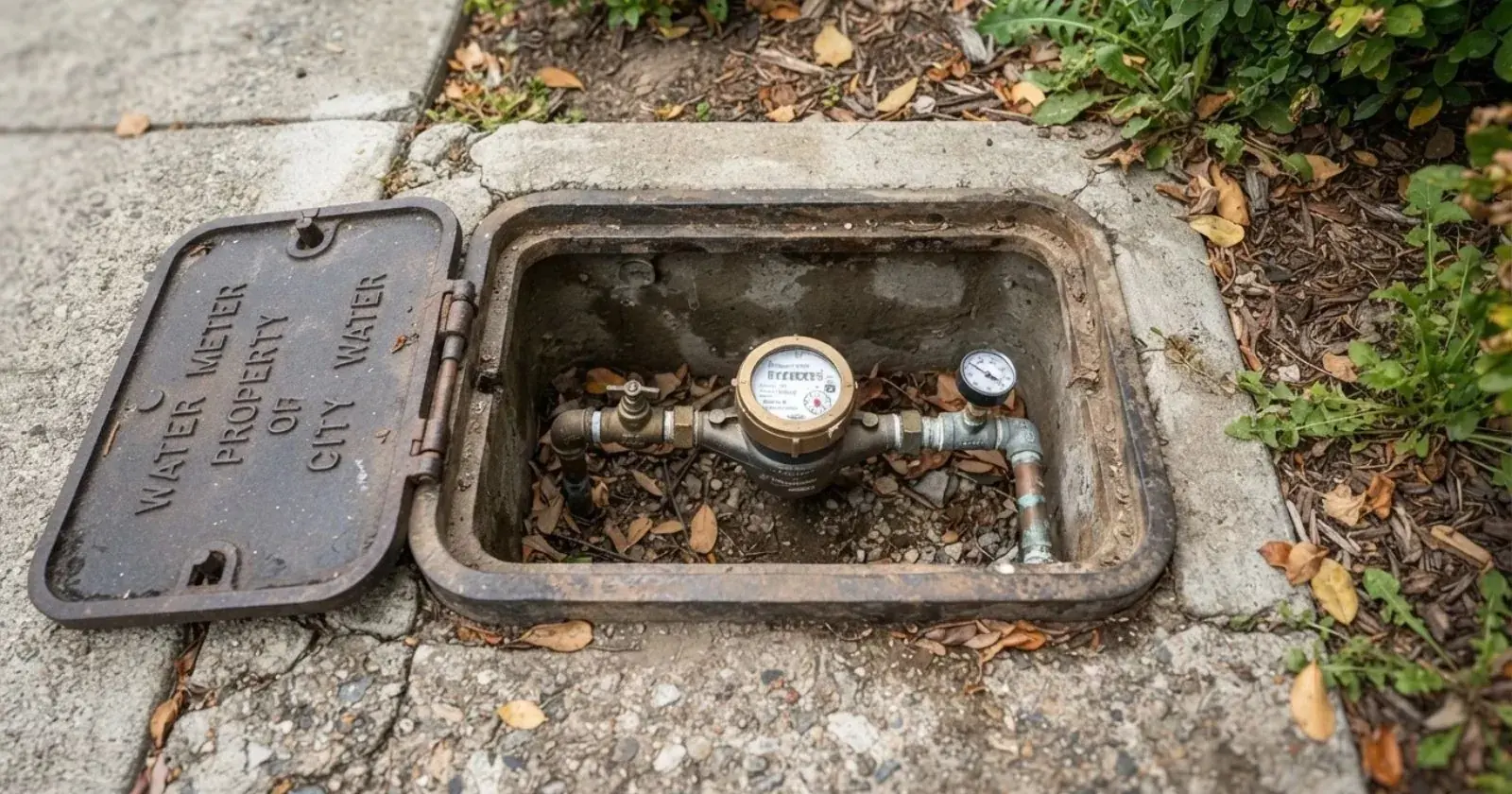
The twenty minute meter test
Do this on a quiet morning when no one is using water.
Shut everything off
Close taps, stop the dishwasher and washer, and turn off the ice maker and softener if you have one.
Find the meter
It is usually in a box near the curb or the front of the property. Lift the lid carefully.
Read and note
Write down the reading, and check the small triangle or wheel that spins when water moves.
Wait and read again
Wait twenty minutes with no use. Any movement means a leak on your side.
What the result means
If the meter did not move, the high bill may come from a rate change, more use or a billing error. Check your bill's usage history against previous months, and review irrigation settings.
If the meter moved, a leak exists between the meter and your fixtures. The next steps narrow it down. Close the main valve at the house and read the meter again. If it stops, the leak is inside the house. If it keeps moving, the leak is in the underground line.
Leak sources by symptom
Match what you find to the likely cause.
| What you find | Likely source | Next step |
|---|---|---|
| Meter moves, stops when house main is shut | Leak inside the house | Check toilets, under sinks, water heater. |
| Meter moves with house main shut | Underground line leak | See water line repair. |
| Meter still, bill is high | Irrigation, use or billing | Review the bill and irrigation timer. |
| Toilet dye test shows color in the bowl | Leaking flapper | See toilet repair. |
| Warm floor spot | Hot water line leak under slab | See slab leak repair. |
Common causes of a high bill
Not every high bill means a pipe is leaking:
- A silent toilet leak that runs all day.
- An irrigation system with a stuck valve or a broken head.
- A leak in the line between the meter and the house.
- A dripping hose bib or outdoor spigot.
- A water heater relief valve that weeps.
- More people at home, a new pool fill or a new appliance.
Where the City's responsibility ends in Galt
The City of Galt maintains the water mains and the meter. The pipe from the meter into your property is your responsibility. That is why a moving meter points to your side, and a call to the City is not the first step.
If you think the meter itself is faulty, contact the City's Utilities Division and ask about testing. For homes in Herald and Wilton on private wells, there is no meter, so look for a pump that runs often or a pressure tank that cycles.
Keep records for your insurer and the City
Take photos of the meter readings with the time, and keep the bills. If a leak damaged the house, your insurer will ask when it started. A record of the test date helps.
Some utilities offer leak adjustments on bills after a documented repair. Ask the City's billing office whether one applies, and keep the plumber's invoice and findings.
Reading the dial correctly
A residential meter shows a register with numbers, usually in cubic feet or gallons, and a small flow indicator. The indicator is a triangle or a wheel that turns when water flows. If it spins with every fixture off, you have a leak.
Take a photo of the register and the indicator before and after your test, with the time. A photo is a better record than a number scribbled on paper, and it settles any argument later about what the meter showed.
What to do with the result
The test gives you three possible next steps:
- If the meter is still, review your bill and your irrigation schedule.
- If the meter moves, find the leak or call a plumber for a locating visit.
- If you cannot tell, repeat the test after an hour with everything off.
- If the meter shows use but the bill seems wrong, ask the City's Utilities Division to check the meter.
- Keep the dated photos in case you ask for a bill adjustment.
- Repair the leak promptly, since water loss continues until it is fixed.
Slow leaks and seasonal use
A small leak may move the meter too slowly to see in twenty minutes. If you suspect one, check the meter at bedtime and again in the morning with nothing running. Any change overnight is a leak.
Seasonal use can also explain a bill. Irrigation in summer raises use in Galt's hot dry months, and a stuck sprinkler valve can run for hours. Check the timer and the valve boxes before you chase a hidden pipe.
How household meters are built
Cold water meters in the United States are commonly built to AWWA C700 series standards, which is why a small flow indicator or a sweep hand shows even tiny flows. That indicator is the part to watch during the test.
When to call a plumber
If the meter moves and you cannot find the leak, call. We use acoustic and thermal tools to locate leaks with minimal damage. See leak detection for the full process.
For a leak you can see, such as water on the ground along the line, shut off the main valve and call the 24/7 line.
Local questions
Twenty minutes is a common minimum. A longer wait catches a slow leak.
A slow spin with everything off usually means a small leak, such as a toilet flapper.
No. The owner maintains the line from the meter to the house.
Yes. A stuck valve or a broken head can use a lot of water.
Yes. The line is open 24/7.