The meter test
This is the single best test, and it costs nothing.
Turn everything off
Close all taps, stop the washer and dishwasher, and turn off the ice maker.
Read the meter
Find the meter at the front of the property and note the dial or the small leak indicator.
Wait twenty minutes
Use no water for at least that long. A longer wait is better.
Read it again
If the reading moved or the leak indicator spins, water is escaping on your side of the meter.
Narrowing the search
A moving meter tells you there is a leak, not where. To narrow it, shut off the main valve at the house and check the meter again. If the meter still moves, the leak is between the meter and the shutoff. If the meter stops, the leak is inside the house.
Inside, shut off the water to the toilets, the water heater and the outdoor lines one at a time. The step that stops the meter points to the problem.
Common hidden leak spots
Check these spots first because they leak most often.
| Spot | How to check | What it means |
|---|---|---|
| Toilet tank | Add food coloring to the tank, wait fifteen minutes | Color in the bowl means a leaking flapper. |
| Under sinks | Run a dry paper towel along the pipes | Damp paper means a fitting leak. |
| Water heater base | Look for rust or water at the base | A leak can be a valve or the tank. |
| Outdoor spigots and irrigation | Walk the lines when the system is off | Wet spots mean a leak in a line. |
| Ceilings and walls | Look for stains or soft paint | A leak above or behind. |
See toilet repair for a running toilet.
Other warning signs
Not every leak shows on the meter test. Watch for these too:
- A musty smell in a closet, cabinet or crawlspace.
- Peeling paint or bubbling drywall.
- A warm spot on the floor, a sign of a hot water line leak, see slab leak repair.
- Hearing water running when nothing is on.
- A sudden high water bill.
- Cracks or buckled flooring.
Where the City stops and your pipes begin in Galt
The City of Galt maintains its water system, including about 105 miles of mains. The line from the meter to your house is yours. That is why the meter test matters so much: a moving meter points to your side, and a stable meter points elsewhere.
If you live in Herald or Wilton on a private well, you do not have a City meter. A well system shows leaks as a pump that cycles often or as a pressure tank that will not hold pressure.
Why speed matters to your insurer
Many policies treat a sudden leak differently from one that went on for months. Records show which one you had. The meter test and photos with dates are useful evidence.
Take photos of the meter readings and any damage, and keep the plumber's invoice. If a claim is likely, ask your carrier before you start repairs.
Outdoor leaks: irrigation and hose bibs
Outdoor lines leak without a stain on any ceiling. Walk the yard with the irrigation off and look for wet spots, green patches or soft soil. Check hose bibs for drips and look at the valve boxes for standing water.
A leaking irrigation line may be a cheap repair, and a leaking supply line to the house is not. The meter test separates them, because the irrigation can be shut off at its own valve.
Tools plumbers use
When the simple tests are not enough, these tools help:
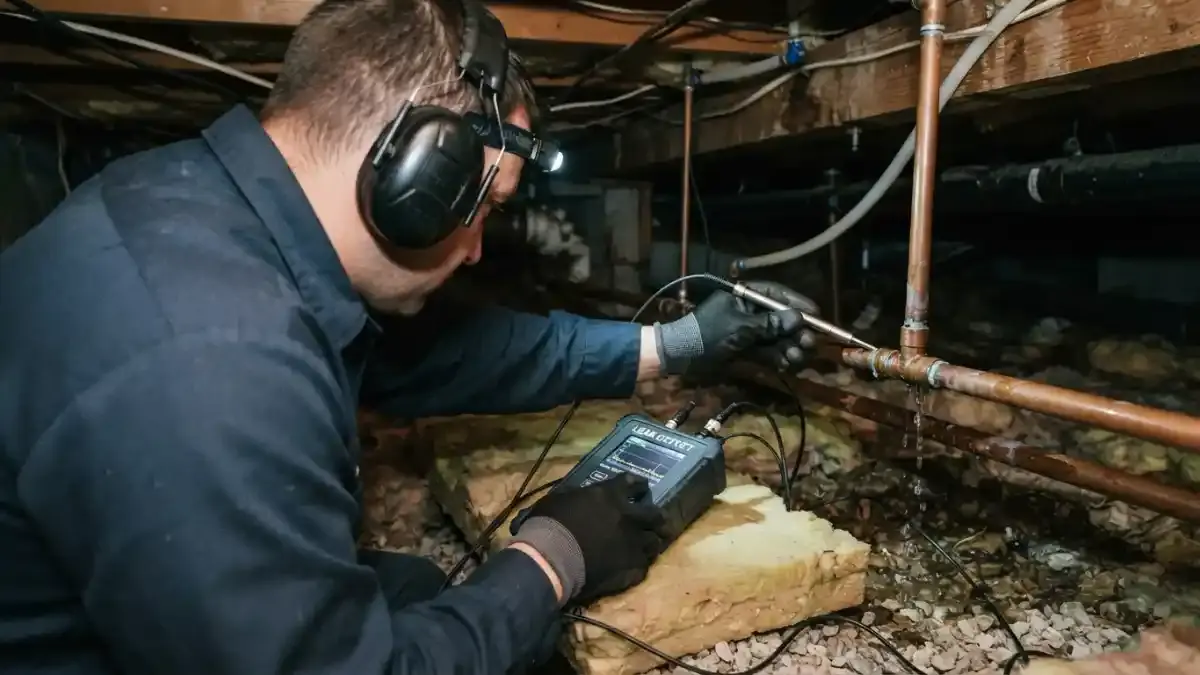
- Acoustic listening devices that hear water escaping from a pipe.
- Pressure gauges that show whether a line holds pressure.
- Thermal cameras that show temperature differences from leaking hot water.
- Moisture meters that read dampness inside walls and floors.
- Tracer gas for lines that are hard to hear.
- Cameras for drains and sewer lines, see sewer inspection.
Keeping a simple leak log
Write down the date, the meter reading and what you did each time you test. A log shows trends, such as a leak that started after a repair or after the irrigation was changed. It also gives the plumber a head start when you call.
A photo of the meter beside a sticky note with the date is enough. Keep these with your bills for a year.
What the EPA recommends
According to the EPA's WaterSense program, checking the water meter with all fixtures off is a standard way to find a leak, and its Fix a Leak Week guidance includes the toilet dye test. The tests in this guide follow that approach.
When to call a plumber
Call when the meter moves and you cannot find the source after the simple checks, or when you find a leak behind a wall or under a slab. We use acoustic and thermal tools to locate leaks with little damage to finished surfaces. See leak detection.
Call the 24/7 line at once for water running through a ceiling, a burst pipe or standing water near electrical outlets.
Local questions
A meter that moves with everything off, a warm floor spot and the sound of running water are the usual signs. A plumber confirms with acoustic tools.
Yes. A silent flapper leak can waste a lot of water. The dye test finds it.
A steady drip can waste thousands of gallons a year, and a hidden line can lose much more.
Policies vary. Some cover the cost to access a covered leak. Ask your carrier.
Yes. A leak makes the pump cycle more often, which wears it out sooner. We can check the plumbing side.