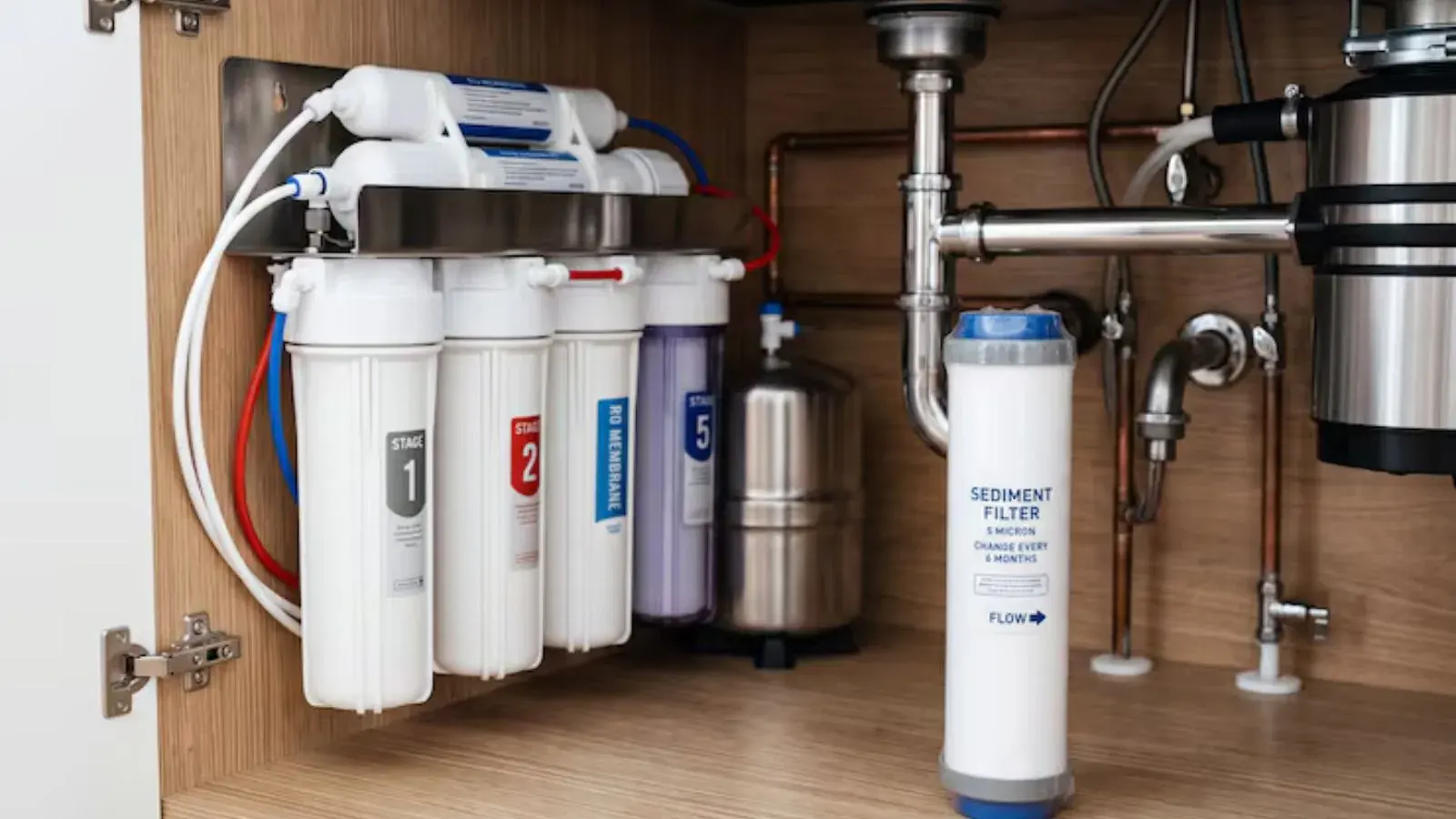
Start with what is in your water
The City of Galt publishes an annual Consumer Confidence Report. The most recent shows soft water, hardness near 34 mg/L, a pH around 7.6 and low average arsenic. The City filters at each well and then chlorinates.
That tells you most Galt homes do not need a softener, and a whole house system may be about taste and chlorine instead of safety. Know your goal before you shop.
System types and what they do
Different goals need different equipment.
| System | What it does | Cost drivers |
|---|---|---|
| Whole house carbon filter | Reduces chlorine taste and odor | Tank size, media, install. |
| Sediment filter | Catches sand and particles | Cartridge size, housing. |
| Water softener | Removes hardness minerals | Capacity, salt use, drain. |
| Reverse osmosis at one tap | Treats drinking water | Membrane, storage, install. |
| UV system | Targets microbes in well water | Lamp, power, flow rate. |
See water softener and filtration for our honest advice.
What drives the cost
Expect these factors in any quote:
- System type and capacity for the size of your household.
- Plumbing changes, including a bypass valve and shutoffs.
- Where it will sit, since a garage is easier than a tight closet.
- Drain and power connections for softeners and UV units.
- Replacement cartridges and media, which are a recurring cost.
- Whether a lab test is needed first, as for a private well.
Ongoing cost matters more than the sticker
A cheap system with expensive cartridges can cost more over five years than a larger system with cheap media. Ask for the cost of replacement filters and how often they change.
Salt for softeners and power for UV lamps are also running costs. Ask for the total over several years, not only the install price.
Galt City water versus wells in Herald and Wilton
Homes in town use the City supply, which is regulated and tested. Homes in Herald and Wilton often use private wells, which are the owner's responsibility to test and treat. Sacramento County guidance after flooding is to test the well and keep it watertight.
A lab test of a private well is the first step. It decides whether you need a filter, a softener, a UV system or nothing. We install after the test, so you pay for equipment that fits the result.
How we advise customers
We try to avoid selling equipment you do not need.
Ask the goal
Taste, scale, a health concern or a well problem each has a different answer.
Check the data
We read the City report or the lab result with you.
Match the equipment
We recommend the smallest system that meets the goal.
Quote the full cost
We give the install price and the yearly upkeep.
Questions to ask before you buy
A careful buyer asks these before signing:
- What contaminant or problem is this system meant to solve for my water?
- Which test result or report supports that claim?
- What does the system cost to run each year, including filters and salt?
- How often does it need service, and who does it?
- What happens to the water pressure through the system?
- What is the warranty and what voids it?
A maintenance schedule to expect
Upkeep varies by system, and this gives a rough picture.
| System | What needs doing | How often |
|---|---|---|
| Sediment filter | Replace the cartridge | Every few months, depending on the water. |
| Carbon filter | Replace media or cartridge | Per the manufacturer, often yearly. |
| Softener | Refill salt, check the brine tank | Every month or two. |
| Reverse osmosis | Replace filters and membrane | Filters yearly, membrane every few years. |
Always follow the manufacturer's schedule over a general guide.
Reading a quote for a filtration system
A good quote lists the equipment by name and size, the install labor, any plumbing changes, and the cost of the first set of filters. It also says what the warranty covers and what voids it, such as skipping scheduled service.
Be wary of a quote that bundles everything into one number with no model names. You cannot compare it with anyone else, and you cannot look up what you are buying. Ask for the model numbers and check them yourself.
Certifications that matter to price
Treatment equipment is tested to NSF/ANSI standards: 42 for aesthetic effects, 53 for health effects, 58 for reverse osmosis and 44 for water softeners. A system without a certification mark for the claim it makes is worth questioning before you pay.
Beware pressure sales
Door to door water treatment sales often use a quick tap test and a claim of a problem. A tap test does not replace a lab test, and the City publishes its own results. Ask for the lab report and the method before signing anything.
If a system is offered with financing, read the total cost. We would rather you keep your money than buy a system that does little.
Local questions
It depends on the system and the plumbing. We quote after a visit, and we list install and yearly upkeep.
Most homes on City water do not. Hardness is around 34 mg/L, which is soft.
It reduces chlorine taste and odor and some organic compounds. It does not soften water.
It is a drinking water preference. A tap level system is usually enough.
We can take a sample and send it to a lab, then explain the result.