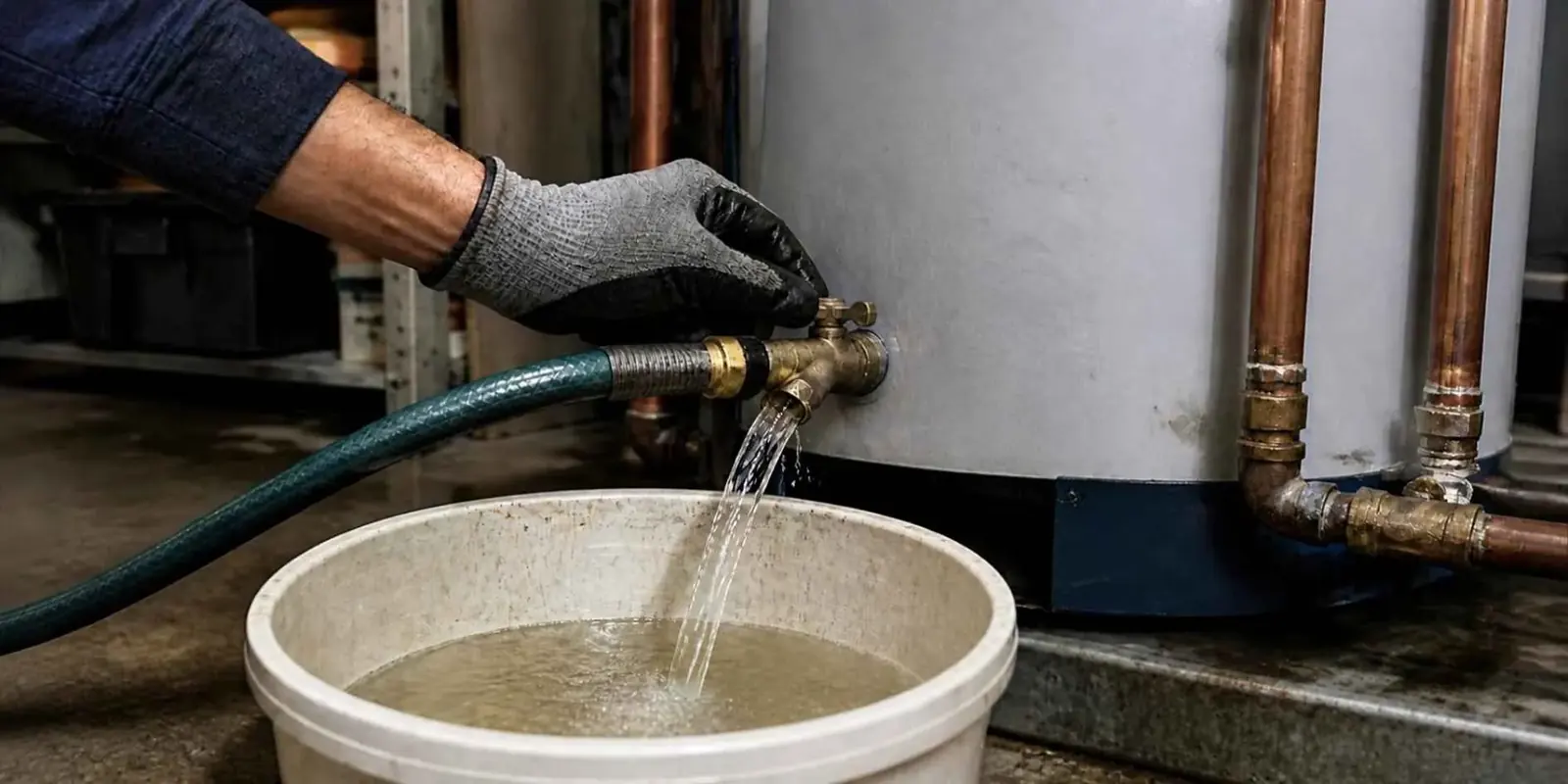
Safety first
Before you touch anything, follow these rules:
- If you smell gas, leave the house and call 911. Do not touch switches.
- For an electric heater, turn off the breaker before you open any panel.
- Never remove the relief valve or block its discharge pipe.
- Do not relight a pilot that keeps going out. Call a plumber.
- If the tank is leaking, shut off the water supply and the fuel or power.
- Do not drain a hot tank. It can cause scalding.
Gas heater checks
Work through these steps in order.
Check the gas valve
Make sure the gas control is on and the gas valve to the heater is open.
Look at the pilot
If it is out, follow the instructions on the label to relight it once.
Check the thermostat
Set it to the middle range, around 120 degrees.
Call if it fails
A pilot that will not stay lit often means a failed thermocouple. Call for water heater repair.
Electric heater checks
Electric tanks have different failure points.
Check the breaker
A tripped breaker is the most common cause. Reset it once.
Press the reset button
Many tanks have a red reset button behind the access panel. Turn off power before opening.
Check the thermostat
A setting that has drifted low can mean lukewarm water.
Call if it trips again
A breaker that trips repeatedly points to a failed element or a wiring fault.
Symptoms and likely causes
Use this table to narrow it down.
| Symptom | Likely cause | Next step |
|---|---|---|
| No hot water, gas | Pilot out or failed thermocouple | Relight once, then call. |
| No hot water, electric | Tripped breaker or failed element | Reset once, then call. |
| Lukewarm water | Thermostat, element or dip tube | Adjust, then call. |
| Water runs out fast | Sediment or a failed lower element | Flush the tank, call if unchanged. |
| Water leaks from the tank | Tank failure | Shut off supply, see water heater replacement. |
Galt's soft water and hot water supply
Galt's water is soft, hardness around 34 mg/L, so sediment and scale build slowly in a tank. A heater that runs out of hot water in a Galt home is less likely to have a scale problem than one in a hard water town.
Check the age of the tank on its label. If the tank is old and rusting at the base, replacement beats repeated repairs. Homes in Herald and Wilton on well water may have more sediment and rust, which wears out tanks sooner.
The strapping check that takes a minute
While you are at the heater, look at the straps. California Health and Safety Code section 19211 requires water heaters to be braced, anchored or strapped. A tank that is not strapped is a hazard in an earthquake.
We add straps during any water heater visit. If you are selling the home, the seller must certify compliance, so it is worth fixing now.
Lukewarm water instead of none
A heater that makes warm but not hot water often has one failed part. On an electric tank, one of two elements may have burned out. On a gas tank, a burner that is partly clogged or a thermostat set too low can do it. A dip tube that has broken lets cold water mix at the top of the tank.
A plumber can test each part in a short visit. The fix is often a replacement element or thermostat, and the tank itself is fine.
Preventing the next outage
A few habits keep a heater running longer:
- Flush a few gallons from the drain valve once a year to move sediment.
- Have the anode rod checked, since it protects the tank from rust.
- Keep the area around the heater clear of boxes and chemicals.
- Test the relief valve once a year by lifting its lever briefly, with a bucket ready.
- Know the heater's age and plan its replacement before it fails.
- Install a leak pan with a drain if the heater sits above living space.
When the heater is fine and the water is still cold
If hot water works at one fixture and not another, the heater is probably fine. A shower valve with a worn cartridge or a mixing valve that has failed can leave one fixture cold. A single faucet with a clogged aerator can also act as if there is no hot water.
Test hot water at two or three fixtures before you blame the tank. If the problem is local, a faucet or valve repair is the fix.
Codes behind a safe water heater
A safe heater has a temperature and pressure relief valve with a discharge pipe, as the UPC based California Plumbing Code requires, and gas units are certified to ANSI Z21.10.1. Never plug or cap the relief valve to stop a drip.
When to call
Call if you smell gas, if the tank leaks, if the breaker keeps tripping or if the pilot will not stay lit. The 24/7 line is open at night and on weekends. We tell you whether a repair or a replacement is the better path.
A quick call can save you from a long cold stretch. See water heater installation if you are planning an upgrade.
Local questions
Common causes are a tripped breaker, an out pilot, a failed thermostat or a failed element. A plumber confirms.
Often an hour or more, depending on tank size.
Yes. Shut off the water and power or gas and call the 24/7 line.
Once, following the label. If it fails again, call a plumber.
Yes. Call and we will dispatch from Galt.