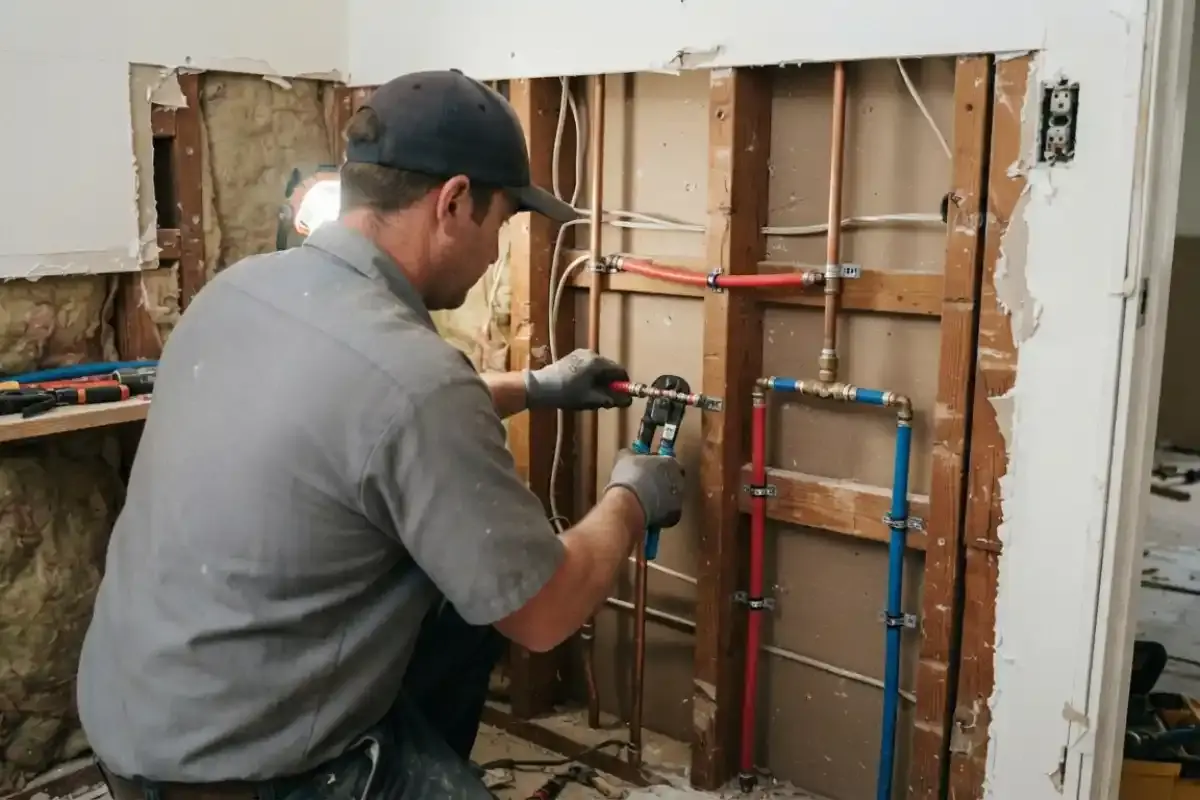
What PEX is
PEX stands for cross linked polyethylene. It is a flexible plastic tubing used for hot and cold water supply inside homes. It comes in red, blue and white, and the colors help installers tell hot from cold lines.
Because it bends around corners, PEX needs fewer fittings than rigid pipe. Fewer fittings mean fewer places to leak, and a faster install.
PEX compared to copper and CPVC
Each material has strengths. This table shows where they differ.
| Question | PEX | Copper | CPVC |
|---|---|---|---|
| Flexibility | High | Rigid | Rigid. |
| Freeze tolerance | Better, it can expand | Can split | Can crack. |
| Installation speed | Fast | Slower, needs soldering | Moderate, uses solvent. |
| Sunlight exposure | Must be shielded | Fine | Can degrade. |
| Long track record | Newer | Longest | Moderate. |
Advantages of PEX
These are the reasons plumbers choose it:
- It is flexible and snakes through walls with fewer fittings.
- It tolerates a freeze better than rigid pipe, though it is not freeze proof.
- It does not corrode or form pinholes from water chemistry.
- It is quieter, with less water hammer noise.
- It costs less than copper for materials.
- It installs quickly, which reduces labor on a repipe.
Drawbacks to know
No pipe is perfect. Here are PEX limits:
- It must be protected from sunlight, since ultraviolet light degrades it.
- It should not be used outdoors in exposed runs.
- It needs the right fittings and the right crimping or expansion tools.
- Rodents can chew it, so protect it in crawlspaces and attics.
- It should not touch certain chemicals such as petroleum products.
- Some people prefer metal pipe for the feel and long record.
PEX for Galt's climate and soil
Galt winters are mild, and a hard freeze is uncommon. Even so, a rare cold snap can split an exposed copper line in an attic or crawlspace, and PEX handles that better. Sacramento County's flood guidance also advises insulating exposed pipes.
The City water in Galt is soft, with hardness around 34 mg/L and a pH of about 7.6, which is gentle on both PEX and copper. For homes in Herald and Wilton on private wells, water chemistry varies, so a lab test helps decide what pipe fits.
When to repipe with PEX
If you have galvanized steel, failing copper with repeated pinholes or a plastic type with a bad history, repiping with PEX is a common choice. The installer runs new lines from a manifold to each fixture, which gives you separate shutoffs and steady pressure.
The decision depends on the house and your budget. See our repiping page for what a repipe involves, and the plumbing installation page for new fixture work.
Fittings and tools: crimp, clamp and expansion
PEX joins with fittings that are crimped, clamped or expanded onto the pipe. Crimp and clamp systems use a ring that is squeezed around the pipe and a barbed fitting. Expansion systems stretch the pipe and a ring, then the pipe shrinks back over the fitting for a tight seal.
Each system needs its own tools and its own fittings. Mixing parts from different systems is a common cause of leaks, and it is the reason we use one system throughout a house.
Myths about PEX
Some claims travel faster than the facts:
- PEX does not leach chemicals at unsafe levels when it is certified for drinking water.
- PEX can freeze, though it tolerates freezing better than rigid pipe.
- PEX is not weak. Properly supported, it carries household pressure for decades.
- PEX is not suitable outdoors in sunlight, which is a fair concern.
- PEX is not cheap in labor terms when a repipe is done right, since the lines still need planning.
- PEX is allowed by the California Plumbing Code for potable water.
What a PEX repipe looks like in a typical Galt home
A repipe follows a pattern that the home dictates.
Choose the manifold spot
A manifold goes in a closet or a garage wall and feeds each fixture by its own line.
Run the lines
We pull flexible lines through attic and wall spaces with as few joints as possible.
Connect the fixtures
We connect toilets, sinks, showers and the water heater to the new lines.
Test and inspect
We pressure test the system, then the Building Division inspects before walls are closed.
Support and protection inside the walls
PEX needs support at regular intervals so it does not sag or rub. The maker and the code set the spacing. Where lines pass through studs, plastic grommets or sleeves keep the pipe from rubbing against wood or metal.
In an attic or crawlspace, protect the pipe from rodents and sunlight. This is the difference between a repipe that lasts decades and one that fails early at a nick or a chewed spot.
Standards for PEX
PEX tubing is made to ASTM F876 and its fittings to ASTM F877 or another listed standard. Drinking water pipe should carry an NSF/ANSI 61 mark, and the UPC based California Plumbing Code allows PEX for potable water.
Questions to ask a plumber about PEX
Ask which PEX type and fitting system they use, since crimp, clamp and expansion systems differ. Ask how the lines will be protected in the attic and under the house. Ask what warranty applies to the pipe and the fittings, and who stands behind the install.
Ask also about permits. A repipe needs one, and the Galt Building Division at (209) 366-7200 handles plumbing permits.
Local questions
PEX pipe sold for potable water is certified for it. Ask your plumber for the certification marks on the pipe.
Manufacturers often cite decades of service. Actual life depends on the installation and water conditions.
It can freeze, but it expands more than rigid pipe and is less likely to split.
Yes. It is allowed under the California Plumbing Code for potable water. A permit is still required for a repipe.
Yes. Call for a quote on a repipe or a partial reroute.